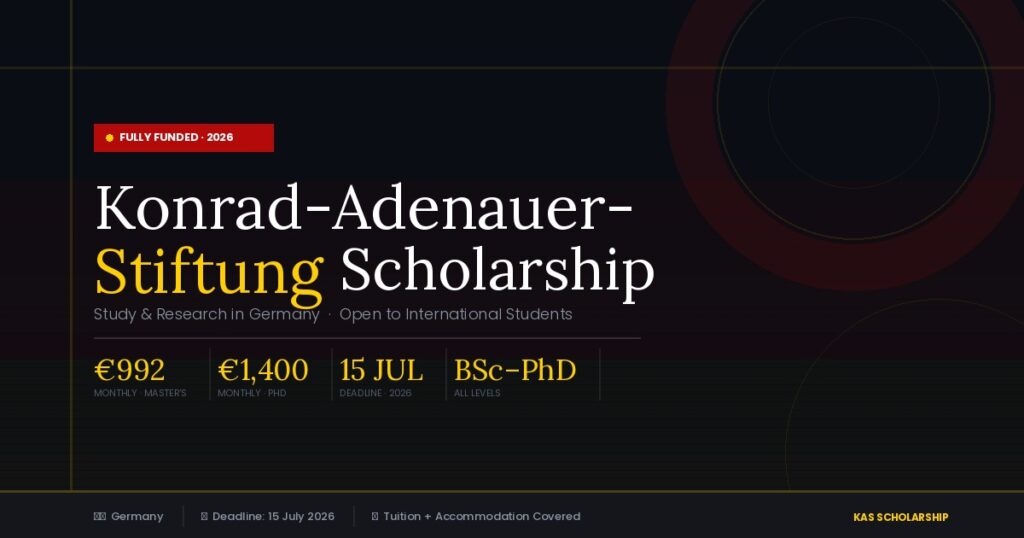
Planning to study in Germany and need financial support? The Konrad-Adenauer-Stiftung Scholarship is worth looking at. It covers tuition, accommodation, and a monthly stipend at German universities across virtually all fields. Below is everything you need to know — benefits, eligibility, required documents, and how to apply.
The 2026–2027 cycle is open to undergraduate, master’s, and PhD students. Master’s recipients get €992 per month; doctoral candidates receive €1,400. Both tuition and accommodation are covered.
KAS awards these scholarships to international students and graduates pursuing study or research at German universities. The program is built around intercultural exchange and international academic networking.
Scholarship at a Glance
- Level: Undergraduate, Master’s, PhD
- Universities: German institutions
- Fields: All programs available at German universities
- Duration: Two years (master’s), three years (PhD)
- Deadline: July 15, 2026 (annual)
What’s Covered
Bachelor’s, master’s, and postgraduate students can receive up to €992 per month for up to two years. PhD candidates get up to €1,400 per month for up to three years, provided they are fully enrolled in a doctoral program at a German university.
Additional allowances are available on request: up to €120/month toward health insurance, €276/month if your spouse lives in Germany for more than three months, and €250 per child with documentation. You can also apply for research travel grants (conferences excluded) and partial tuition reimbursement of up to €750 per semester in exceptional circumstances.
Eligibility
- German language: Minimum B2 level, such as a Goethe-Institut certificate
- Academic record: Good to excellent grades, with genuine curiosity beyond your own discipline
- Values alignment: Familiarity with the Konrad Adenauer Foundation’s principles; ability to engage critically with social and political questions while respecting other viewpoints
- Community involvement: Active participation in politics, social work, church, or cultural activities; commitment to democracy and human rights
- Initiative: Willingness to contribute to the non-financial support program and your local university group, and to maintain ties between your home country and Germany after graduating
- Motivation: Goal-oriented and open to academic and personal growth
How to Apply
Two routes are available:
- Through a KAS office abroad — If you are still in your home country, apply via your local KAS office. Click here for a current list of offices.
- Domestic application — If you already live in Germany, apply through the KAS Campus Portal.
Required documents for all applicants:
- CV in tabular format, including voluntary work or community involvement
- Motivation letter
- Examination certificates (in German translation if the originals are not in English)
- University transcripts, if you have studied at a German institution
- Proof of German language proficiency (B2)
- Academic letter of recommendation from a university professor or lecturer holding a doctoral degree (must be no older than two months; should address your academic qualifications and potential)
- Personal letter of recommendation addressing your values, social commitment, and personality (must be from a different author than the academic reference)
- Certificate of admission or matriculation from your German university
Additional documents for PhD applicants:
- Doctoral thesis exposé written in German or English (5–10 pages, font size 12, 1.5 line spacing), covering the central research question, scientific relevance, theoretical approach, research motivation, work schedule, and bibliography
- Second academic letter of recommendation from your doctoral supervisor, if you already have one (this replaces the personal reference letter)
- Confirmation of supervision from your doctoral supervisor