Every Kenyan professional faces this critical moment: sitting across from an HR manager or receiving a job offer email, knowing that what happens next will determine their financial future for years to come. Yet most job seekers in Kenya leave tens of thousands—sometimes hundreds of thousands—of shillings on the table simply because they don’t know how to negotiate.
The truth is stark: In Kenya’s competitive 2026 job market, the difference between accepting the first offer and negotiating strategically can mean an extra KES 50,000 to 200,000 per month for mid-level positions. Over a career, that’s millions of shillings lost to silence.
This comprehensive guide reveals the salary negotiation tactics that top Kenyan professionals use to maximize their compensation—whether you’re negotiating your first job, switching careers, or pushing for a raise in your current role.
Why Most Kenyan Job Seekers Fail at Salary Negotiation
Before we dive into winning strategies, let’s address why negotiation fails for most people:
The “Grateful to Have a Job” Mindset Many Kenyan job seekers approach offers with excessive gratitude, viewing any employment as a favor rather than a mutually beneficial exchange. This mindset immediately weakens your negotiating position. Remember: Companies hire you because they need your skills and value—not as charity.
Cultural Hesitation Around Money Talk Kenyan culture often treats direct money discussions as uncomfortable or even rude. While politeness matters, excessive shyness about compensation costs you real money. Professional salary negotiation is expected in modern workplaces—employers actually respect candidates who advocate for themselves intelligently.
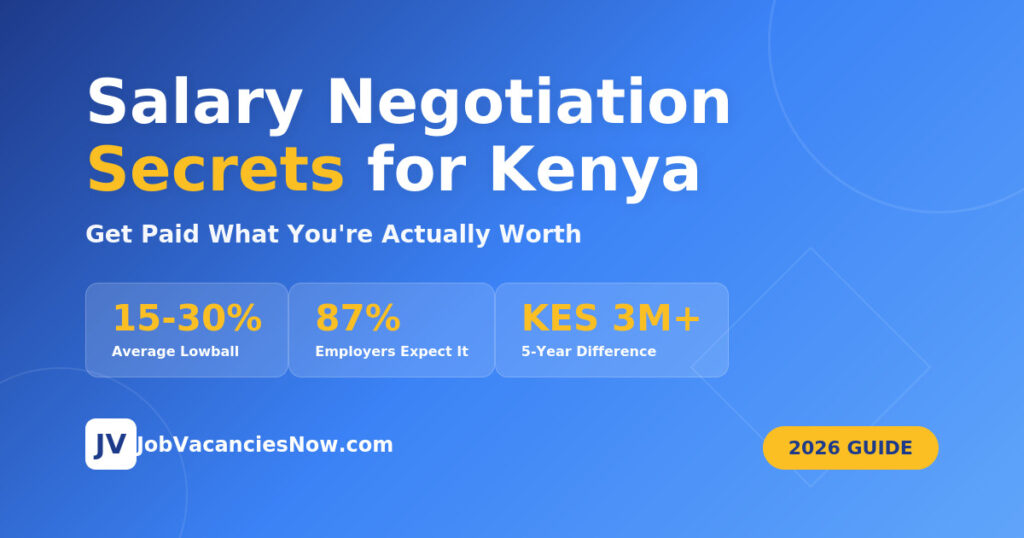
Fear of Losing the Offer “What if they withdraw the offer?” This fear paralyzes thousands of Kenyan job seekers into immediate acceptance. The reality? Legitimate employers almost never rescind offers because you negotiated professionally. In fact, 2026 research shows that 87% of Kenyan employers expect some negotiation and budget for it.
Information Asymmetry You don’t know what the position typically pays, what your predecessor earned, or what the company can actually afford. Meanwhile, HR knows exactly what you earned in your last job (if you disclosed it) and what competitors pay. This information gap puts you at a severe disadvantage.
Accepting the First Number Perhaps the costliest mistake: accepting the initial offer immediately. First offers are almost never the best offers. Companies typically lowball by 15-30% in Kenya, expecting negotiation.
The Kenyan Salary Landscape in 2026: What You Need to Know
Understanding current market realities helps you negotiate from strength:
Sector-Specific Salary Ranges (2026 Data)
Technology & IT:
- Junior Developer: KES 60,000 – 120,000
- Mid-level Developer: KES 150,000 – 300,000
- Senior Developer/Tech Lead: KES 350,000 – 600,000
- IT Manager/CTO: KES 600,000 – 1,500,000+
Finance & Banking:
- Accountant (Entry): KES 50,000 – 90,000
- Financial Analyst: KES 120,000 – 250,000
- Senior Accountant/Finance Manager: KES 250,000 – 500,000
- CFO/Finance Director: KES 800,000 – 2,000,000+
Marketing & Communications:
- Marketing Officer: KES 55,000 – 100,000
- Digital Marketing Specialist: KES 80,000 – 180,000
- Marketing Manager: KES 200,000 – 400,000
- Head of Marketing: KES 450,000 – 900,000
Sales:
- Sales Representative: KES 40,000 – 80,000 (plus commission)
- Account Manager: KES 100,000 – 200,000 (plus commission)
- Sales Manager: KES 250,000 – 500,000 (plus commission)
- Regional Sales Director: KES 600,000 – 1,200,000 (plus commission)
Human Resources:
- HR Officer: KES 50,000 – 95,000
- HR Business Partner: KES 120,000 – 220,000
- HR Manager: KES 220,000 – 450,000
- HR Director/CHRO: KES 500,000 – 1,000,000+
Engineering (Non-Software):
- Graduate Engineer: KES 50,000 – 90,000
- Project Engineer: KES 100,000 – 200,000
- Senior Engineer: KES 220,000 – 400,000
- Engineering Manager: KES 450,000 – 800,000
Industry Pay Differences The same role can pay vastly differently depending on industry:
- Tech startups and international companies typically pay 20-40% more than traditional Kenyan corporations
- NGOs and UN agencies often offer competitive base salaries plus excellent benefits
- Government and parastatal positions may have lower base pay but stronger job security and benefits
- Financial services consistently pays premium salaries but demands longer hours
Remote Work Revolution The 2026 remote work explosion has created new salary dynamics. Kenyan professionals working for international companies can now earn 2-5x local market rates, with some senior developers commanding $4,000-8,000 monthly (KES 520,000 – 1,040,000) from US/European companies.
Before You Negotiate: Essential Preparation
Successful negotiation starts long before the actual conversation. Here’s your preparation roadmap:
Research Phase (2-3 Weeks Before)
1. Know Your Market Value Don’t guess—research systematically:
- Check salary surveys on BrighterMonday, Fuzu, and LinkedIn Salary Insights
- Join industry-specific WhatsApp groups and Telegram channels where Kenyans share salary data
- Review Glassdoor Kenya salary data for the specific company
- Connect with people in similar roles via LinkedIn and have casual salary conversations
- Use online salary calculators adjusted for Kenyan market conditions
Create a salary range based on your research: your minimum acceptable (walk-away number), your target (realistic expectation), and your optimistic (high but justifiable).
2. Document Your Value Proposition Build a concrete case for why you deserve premium compensation:
- Quantifiable achievements from previous roles (revenue generated, costs saved, efficiency improved)
- Specialized skills or certifications that are in high demand
- Relevant experience that directly applies to the new role
- Unique combinations of skills (e.g., technical + business fluency)
- Examples of leadership, initiative, or innovation
- Educational qualifications and continuous learning
Write this down. You’ll need specific examples during negotiation.
3. Understand the Complete Compensation Package Salary is just one component. In Kenya, benefits can add 20-40% to your total compensation:
- Housing allowance
- Medical insurance (personal and dependents coverage)
- Annual leave days beyond statutory minimum
- Performance bonuses and 13th-month pay
- Retirement contributions (pension/provident fund)
- Professional development budget
- Commuter/transport allowance
- Lunch allowance
- Communication allowance (airtime/internet)
- Remote work equipment and stipends
- Stock options or equity (especially in startups)
- Relocation assistance
Know which benefits matter most to you so you can negotiate strategically.
4. Research the Specific Company Understand who you’re negotiating with:
- Company financial health (profitable companies can pay more)
- Growth trajectory (scaling companies need talent urgently)
- Compensation philosophy (some companies pay top-of-market, others don’t)
- Recent funding rounds (startups with fresh capital often have budget flexibility)
- Employee reviews on Glassdoor regarding compensation fairness
This context helps you gauge how much negotiating room exists.
Timing Strategies
When to Discuss Salary:
- NEVER bring up compensation first if possible—let the employer make the initial offer
- If pressed early: “I’m more focused on finding the right role fit. Once we’re both excited about the opportunity, I’m confident we can reach fair compensation.”
- Ideal timing: After you’ve demonstrated value through interviews but before accepting an offer
When to Negotiate:
- After receiving a written offer (never negotiate a verbal offer)
- When you have competing offers or current employment (strong leverage)
- After you’ve received positive signals about your candidacy
- When you’re genuinely willing to walk away if terms aren’t met
The Kenyan Salary Negotiation Playbook: Step-by-Step Tactics
Phase 1: Receiving the Offer
When you receive an offer—whether via email or phone—your immediate response sets the tone.
What to Say: “Thank you so much for this offer. I’m very excited about the opportunity to join [Company] and contribute to [specific project/goal]. I’d like to take some time to review the complete offer package carefully. Could you send me all the details in writing? I’ll get back to you by [specific date, typically 2-3 business days later].”
What This Accomplishes:
- Expresses enthusiasm (important—you want the job)
- Buys you time to analyze and prepare
- Establishes you as thoughtful and professional
- Gets everything in writing (essential for negotiation)
What NOT to Say:
- “Yes, I accept!” (never accept immediately)
- “That’s lower than I expected” (shows your cards too early)
- “Let me talk to my spouse/parents” (suggests you lack decision-making authority)
Phase 2: Analyzing the Offer
Once you have the written offer, analyze it systematically:
Create a Compensation Spreadsheet:
Component          | Offered Amount | Market Average | My Target
Base Salary        | KES 150,000    | KES 180,000   | KES 200,000
Housing Allowance  | KES 25,000     | KES 30,000    | KES 35,000
Medical Cover      | Comprehensive  | Comprehensive | Comprehensive
Annual Bonus       | 1 month        | 1-2 months    | 2 months
Leave Days         | 21 days        | 21-24 days    | 24 days
[etc.]             |                |               |

Total Monthly Value: KES 175,000 vs. Target: KES 235,000
Gap: KES 60,000 (25.5% below target)
This clarity helps you prioritize what to negotiate and by how much.
Identify Your Leverage Points:
- Other job offers in hand (strongest leverage)
- Current employment (second strongest)
- Specialized skills they desperately need
- Competing candidates they’ll need to interview again
- Their hiring urgency
- Your unique qualifications
Phase 3: The Negotiation Conversation
Now comes the actual negotiation. Whether via phone, video call, or in-person meeting, follow this structure:
Opening (Express Enthusiasm First): “Thank you again for the offer. After reviewing everything carefully, I’m even more excited about joining the team and contributing to [specific goal/project]. I can see myself making a real impact on [specific area].”
Why this matters: You must maintain enthusiasm throughout. Employers need to know you genuinely want the role—negotiation isn’t about being difficult, it’s about reaching fair terms for a position you’re excited about.
The Ask (Be Specific and Direct): “Based on my research of market rates for this role and my [X years of experience / specialized skills / track record of achievements], I was hoping we could discuss compensation. Specifically, I was targeting a base salary in the range of KES [your target number] to KES [slightly above target].”
Alternative approach if they’re far below: “I’m thrilled about the opportunity, and I want to make this work. However, there’s a significant gap between the offered compensation and what I was expecting based on market research and my experience. For me to move forward, I’d need to see the base salary at least at KES [your minimum acceptable number].”
Critical Rules:
- Always give a range, not a single number (gives you negotiating room)
- Your minimum should be your actual walk-away number
- Justify your ask with concrete data (market rates, your experience, your achievements)
- Never apologize for negotiating (“I’m sorry, but…”)
- Stay collaborative, not adversarial (“I want to find a solution that works for both of us”)
Present Your Case (Support Your Ask): “This number is based on several factors:
- Market research showing similar roles at [competitor companies] paying between KES X and Y
- My [specific achievement, e.g., ‘success increasing revenue by 40% in my current role’]
- My [relevant certification/education, e.g., ‘CPA certification and 5 years Big Four experience’]
- The value I can bring to [specific business problem they mentioned in interviews]”
Handle Their Response:
If they say yes immediately: You probably asked too low. Still, accept graciously: “That’s wonderful. I’m excited to join the team.”
If they say “Let me check with management/finance”: “I appreciate that. When can I expect to hear back?” (Get a specific timeline)
If they counter lower than your target: Don’t immediately accept or reject. “I appreciate you coming up to KES [their counter]. I’m still hoping we can close the gap. Is there any flexibility to reach KES [midpoint between their counter and your target]?”
If they say “This is our final offer”: Test whether it’s truly final: “I understand budget constraints. If the base salary can’t move, could we explore other components like [housing allowance/signing bonus/additional leave/earlier performance review]?”
Phase 4: Negotiating Beyond Base Salary
If base salary won’t budge, negotiate other valuable components:
High-Impact Alternatives:
- Signing Bonus: One-time payment that doesn’t affect ongoing budget. “Could we bridge the salary gap with a signing bonus of KES [amount]?”
- Performance Review Timeline: “Would it be possible to schedule my first performance review at 6 months instead of 12 months, with a salary adjustment based on performance?”
- Housing/Transport Allowance: These are often more flexible than base salary. “Could we increase the housing allowance from KES X to KES Y?”
- Remote Work Days: Saves you commute costs and time. “Would it be possible to work remotely 2-3 days per week?”
- Additional Leave Days: Especially valuable for work-life balance. “Could we add 3-5 additional annual leave days?”
- Professional Development Budget: “Would the company provide KES X annually for courses, conferences, or certifications?”
- Earlier Promotion Timeline: “Could we establish clear milestones for promotion to [next level] within 12-18 months?”
- Guaranteed Bonus: “Could we make the annual bonus guaranteed rather than discretionary for the first year?”
- Better Medical Coverage: “Could we upgrade to a plan that includes dental and optical coverage for my dependents?”
- Stock Options/Equity: Especially in startups: “Would there be any equity component to the compensation package?”
The Bundling Strategy: Instead of asking for one thing at a time, bundle several requests: “If we can’t reach KES [target salary], could we combine a higher housing allowance, an additional week of leave, and a 6-month performance review cycle?”
This gives the employer flexibility to say yes to some items even if they can’t approve everything.
Phase 5: Handling Objections
Employers will push back. Here’s how to handle common objections:
“This is above our budget for the role.” Response: “I understand budget constraints. Help me understand—is the budget set based on market rates for someone with my level of experience? Could we revisit the budget given the value I can bring, particularly in [specific high-impact area]?”
“We need to maintain internal equity.” Response: “I appreciate the importance of internal equity. However, I’m being hired for a role with [specific specialized responsibilities] that may differ from current team members. Additionally, market rates have shifted significantly. How do you typically handle bringing in senior talent in competitive markets?”
“You’re already getting more than your current salary.” Response: “While I appreciate that the offer is an increase, my current salary isn’t the right benchmark. I’m actually being underpaid in my current role, which is part of why I’m seeking new opportunities. The relevant benchmark is market rate for the value I’ll deliver in this position.”
“We can revisit this after you prove yourself.” Response: “I’m confident I’ll exceed expectations. However, I’ve learned that initial compensation sets the baseline for future increases. It’s much easier to start at the right level than to catch up later. Could we establish the fair market rate now, with performance bonuses beyond that?”
“We’ve never paid this much for this position before.” Response: “I understand. The market has evolved significantly, especially with the remote work changes and increased demand for [your skills]. Companies that want to attract top talent are adjusting their ranges accordingly. I’m bringing [specific unique value] that justifies premium compensation.”
“Other candidates would accept this offer.” Response: “I’m sure that’s true, and I respect that you have options. I also know you wouldn’t have made me an offer if you didn’t see something special in my candidacy. I’m very excited about this role and I want to join the team—I just need us to reach terms that reflect the value I’ll deliver.”
Phase 6: Closing the Deal
Once you’ve negotiated and reached agreement:
1. Get Everything in Writing “This all sounds great. Could you send me an updated offer letter reflecting our discussion—specifically [list each agreed item: base salary of KES X, housing allowance of KES Y, 6-month review cycle, etc.]?”
Never resign from your current job or turn down other offers until you have a signed, written offer.
2. Express Enthusiasm “I’m thrilled we could reach an agreement that works for both of us. I can’t wait to join the team and start contributing to [specific project/goal].”
3. Clarify Start Date and Next Steps “What are the next steps? I’ll need to give [X weeks] notice to my current employer. Would a start date of [specific date] work?”
4. Accept Graciously Send a brief, professional email confirming your acceptance:
“Dear [Hiring Manager],
I’m pleased to formally accept the position of [Title] at [Company] at the terms we discussed: [briefly list key components]. I’m excited to join the team and contribute to [specific goal].
I will provide my notice to my current employer immediately and confirm a start date of [date]. Please let me know if you need any additional information or documentation.
Thank you again for this opportunity.
Best regards, [Your Name]”
Special Scenarios: Advanced Negotiation Situations
Negotiating a Raise in Your Current Job
The process differs slightly when negotiating with your current employer:
Preparation:
- Document your achievements over the past year with specific metrics
- Research current market rates for your role
- Choose optimal timing (after a major success, during performance review cycles, when company is doing well financially)
- Prepare to discuss your future contributions, not just past performance
The Ask: “I’d like to discuss my compensation. Over the past [time period], I’ve [specific achievements with metrics]. Additionally, I’ve researched market rates and found that similar roles are paying between KES X and Y. Given my contributions and the current market, I’d like to discuss adjusting my salary to KES [target], which is within market range and reflects the value I’m delivering.”
If They Say No: Don’t threaten to leave unless you’re truly willing to (and have other options). Instead: “I understand. Could we discuss a roadmap for getting there? What specific goals or achievements would need to happen for us to revisit this conversation in [3-6 months]?” Get commitments in writing.
Negotiating with Multiple Offers
Having multiple offers dramatically increases your leverage:
The Leverage Play: “I’m very excited about this opportunity with [Company A]. I want to be transparent—I’m also considering an offer from [Company B] at KES [their offer amount]. However, [Company A] is my preference because of [genuine reason: culture fit, growth opportunity, specific project, etc.]. Is there any flexibility to match or exceed the competing offer?”
Critical Rules:
- Only mention competing offers if they genuinely exist (lying will burn bridges)
- Express genuine preference (employers won’t compete for someone who doesn’t want the job)
- Be prepared to share the competing offer letter if asked
- Don’t play companies against each other too aggressively—stay professional
Negotiating as a Fresh Graduate
Entry-level positions have less negotiating room, but you still have options:
What You CAN Negotiate:
- Start date (if you need time to relocate or finish commitments)
- Remote work days
- Professional development budget
- Performance review timeline
- Specific projects or team placement
What’s Usually Fixed:
- Base salary (often in standardized bands for graduates)
- Core benefits
Your Approach: “I’m very excited about this opportunity. I understand the salary structure for graduate positions. However, I’d love to discuss [specific professional development opportunities / project assignments / team placement] that would help me grow quickly and deliver maximum value to the company.”
Negotiating in Economic Downturns
When the economy is uncertain or your industry is struggling:
Acknowledge Reality: “I understand these are challenging economic times. I’m flexible on the structure of compensation. Could we explore a base salary of KES [slightly lower than normal] with a performance-based bonus structure that rewards specific achievements?”
Focus on Value: Emphasize how your skills solve current business problems: “In this environment, [your specific skill, e.g., cost optimization, digital transformation, customer retention] is especially valuable. My track record shows [specific relevant achievement].”
Request Future Reviews: “Given market uncertainty, could we agree to a formal compensation review in 6 months when we’ll have better visibility into business performance?”
Common Negotiation Mistakes Kenyan Professionals Make (And How to Avoid Them)
Mistake 1: Revealing Your Current Salary Too Early When asked “What’s your current salary?” in early interviews, this question is designed to anchor negotiations low.
Better responses:
- “I’m looking for a total compensation package in the range of KES X to Y, based on market research for this role and my experience.”
- “My current package includes several non-standard components. I’d prefer to focus on the value I can bring to this role. Once we’re both excited about the fit, I’m confident we can reach fair compensation.”
- “What’s the budgeted range for this position?” (turning the question back)
If pressed: “My current employer considers that confidential information, but I can tell you that I’m looking for a [X%] increase to make a move.”
Mistake 2: Accepting the Offer Verbally Before Seeing It in Writing Verbal offers often differ from written ones. Always say: “I’m excited! Please send me the formal written offer so I can review all the details.”
Mistake 3: Negotiating via Email When a Call Would Be Better Email makes it easy for employers to say no. For major negotiations, request a phone call: “I’d love to discuss the offer in detail. Could we schedule a brief call?” Tone and dialogue help build rapport and find creative solutions.
Mistake 4: Making It Personal (“I Need This Because…”) Avoid: “I need KES X because my rent is expensive / I have children / I have debts.” Your personal financial needs are not the employer’s concern. Instead, justify requests with professional value: “I’m requesting KES X based on market rates and the value I’ll deliver.”
Mistake 5: Being Vague Avoid: “I was hoping for more.” Be specific: “Based on my research and experience, I was targeting KES [exact number].”
Mistake 6: Negotiating Multiple Times You typically get one good negotiation round. Don’t go back and forth repeatedly (“Actually, can we also…”). Bundle all your requests in one thoughtful conversation.
Mistake 7: Burning Bridges Even if negotiations fail and you decline the offer, stay professional: “Thank you for the opportunity and for working with me on compensation. Unfortunately, I’ve decided to pursue another direction. I hope our paths cross again in the future.” You may work with these people later in your career.
Mistake 8: Not Knowing Your Walk-Away Number Before negotiating, decide: “What’s the absolute minimum I’ll accept?” If they can’t meet it, be prepared to politely decline. Accepting below your walk-away number leads to resentment and job dissatisfaction.
The Psychology of Negotiation: Mindset Matters
Beyond tactics, your mindset determines negotiation success:
Abundance Mentality vs. Scarcity Mentality Scarcity: “I must accept this offer or I’ll never find another job.” Abundance: “Quality opportunities exist. If this doesn’t work out, another will.”
The abundance mindset allows you to negotiate confidently because you’re not desperate. Even if you feel desperate, don’t show it.
You’re Selling Value, Not Asking for Favors Reframe negotiation: You’re not begging for more money. You’re ensuring fair exchange of value. The company needs your skills; you need fair compensation. It’s a business transaction, not charity.
Confidence (Even If You Don’t Feel It) Deliver your negotiation points with calm confidence. Practice your key phrases aloud beforehand. Speak clearly, at a moderate pace, and don’t apologize for advocating for yourself.
Silence Is Power After making your ask, stop talking. Let them respond. Many people get nervous and immediately start walking back their request (“But I’m flexible…”). State your position, then wait.
Long-Term Thinking A KES 50,000 monthly salary difference compounds over time:
- Year 1: KES 600,000 additional earnings
- Over 5 years: KES 3,000,000+ (assuming modest raises)
- Over a career: KES 10,000,000+
Negotiating isn’t petty—it’s protecting your financial future.
Red Flags: When to Walk Away
Some offers aren’t worth negotiating. Walk away if you see these warning signs:
- They Rescind the Offer When You Negotiate Professionally: This suggests a toxic culture that doesn’t value advocacy. You dodged a bullet.
- They Won’t Put the Offer in Writing: Verbal promises are worthless. If they refuse to document terms, something is wrong.
- The Package Is 30%+ Below Market Despite Negotiation: You’ll be underpaid and resentful. Keep looking.
- They’re Dishonest or Deceptive: If they lie about benefits, salary ranges, or job responsibilities during hiring, they’ll lie as an employer.
- Excessive Pressure to Accept Immediately: “You must decide by end of day.” This is a manipulation tactic. Professional offers give you reasonable time (3-5 business days minimum).
- You’d Be Financially Stressed: If even the negotiated salary won’t cover your basic needs, declining is the right move. Financial stress destroys job performance and wellbeing.
Your Negotiation Preparation Checklist
Use this checklist before your next salary negotiation:
Research Phase: ☐ Researched market salary ranges for the role (minimum 3 sources) ☐ Checked Glassdoor salary data for the specific company ☐ Talked to 2-3 people in similar roles about compensation ☐ Documented my specific achievements with metrics ☐ Listed my unique skills and qualifications ☐ Understood the full benefits package components
Strategy Phase: ☐ Determined my minimum acceptable salary (walk-away number) ☐ Set my target salary range ☐ Identified my top 5 benefits priorities beyond salary ☐ Researched the company’s financial health and hiring urgency ☐ Prepared my value proposition (why I deserve this compensation) ☐ Identified my leverage points (other offers, current job, unique skills)
Tactical Phase: ☐ Received the offer in writing ☐ Analyzed the complete compensation package ☐ Calculated the gap between offer and target ☐ Practiced my negotiation script aloud ☐ Prepared responses to common objections ☐ Scheduled the negotiation call/meeting ☐ Set a reminder to get the final agreement in writing
Conclusion: Your Compensation Is Your Choice
Here’s the truth that most Kenyan job seekers don’t realize: Your salary is not determined by what employers want to pay. It’s determined by what you’re willing to accept.
Every time you negotiate professionally, you’re not just earning more money in that specific role. You’re:
- Setting a higher baseline for all future salary negotiations (since new employers often ask about current compensation)
- Demonstrating professional maturity and business savvy
- Signaling that you value your worth
- Practicing a critical career skill that compounds over decades
- Building financial security for yourself and your family
The job seekers who earn significantly more over their careers aren’t necessarily more talented or harder working. They’re simply better at negotiating—and they negotiate every time.
Start now. Whether you’re evaluating a new offer or preparing to request a raise, use these strategies to ensure you’re paid what you’re worth.
Your skills have value. Your experience matters. Your contributions deserve fair compensation.
Now go get paid.
Looking for more job search strategies? Check out our complete guides on:
- CV optimization for the Kenyan market
- LinkedIn profile strategies that attract recruiters
- Interview preparation and question handling
- Remote job opportunities for Kenyan professionals
- UN and NGO application tactics
Your next career move starts with knowing your worth—and negotiating for it.